

Research › Measuring groups
CEP 50 and 90 explained
GroupLab project, tested by Alan Hayes, researched and written with Claude. Written 2026-09-22; the data is from Simulation, seed 2026.
This article is a draft. It is not finished, it is not linked from the research index, and anything in it may change.
What we found
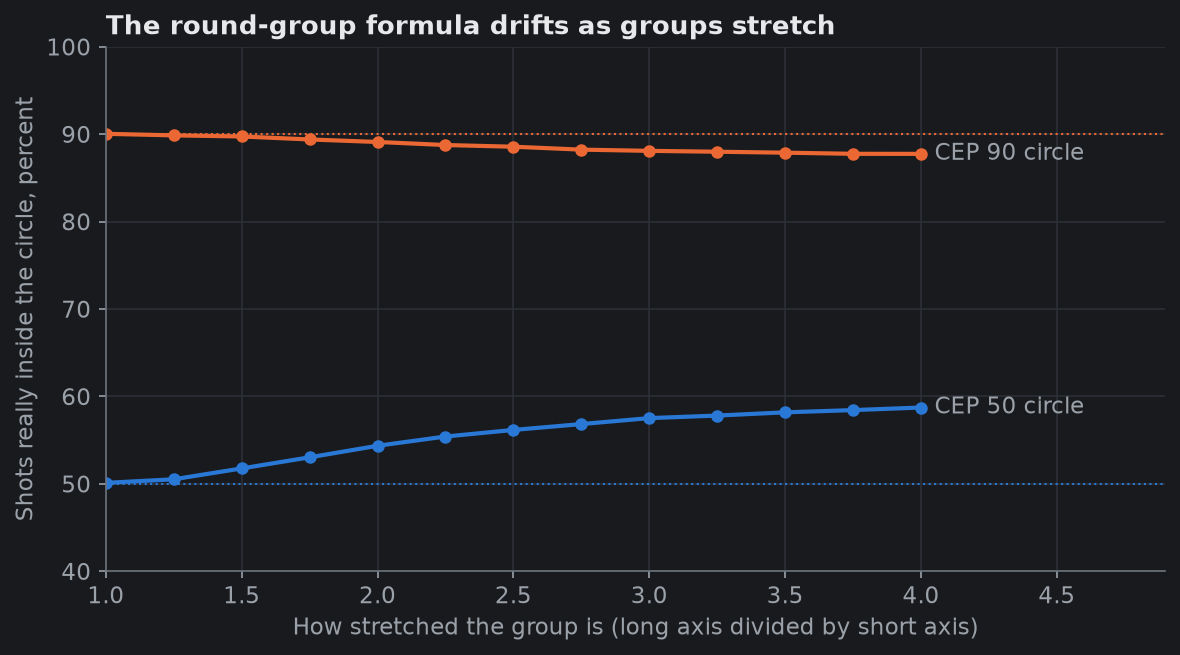
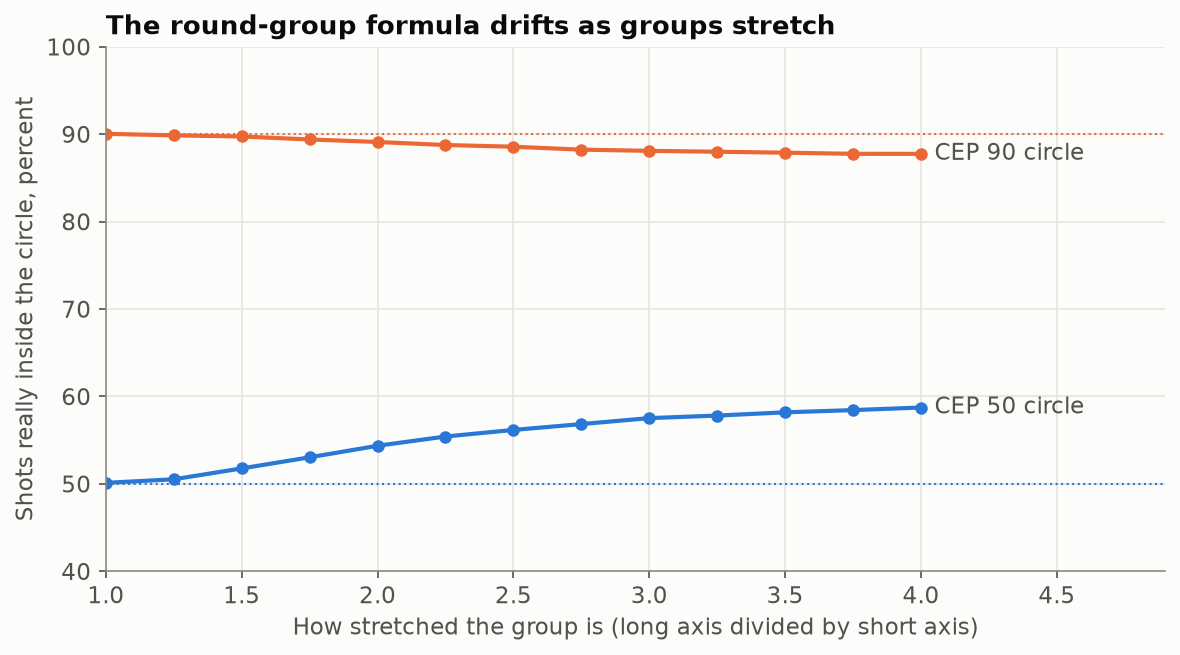
for a round group, CEP 50, mean radius and CEP 90 are fixed multiples of the same underlying spread: 1.18, 1.25 and 2.15 sigma. They are three views of one number. When a group stretches to twice as wide as it is tall, the round-group CEP 50 circle holds about 54 percent of shots instead of 50, and the CEP 90 circle about 89 percent instead of 90.
How sure we are
exact for the model; the stretched-group figures are from 400,000 simulated shots per shape. Real groups with flyers break every one of these formulas, which is why GroupLab handles flyers separately.
The data
A circle that answers a practical question
Mean radius tells you the average distance of a shot from the group centre. CEP answers a question that is often more useful in the field: how big a circle do I need to hold a given share of my shots?
- CEP 50 is the radius of the circle, centred on the group, that holds half your shots.
- CEP 90 holds nine shots in ten.
If your CEP 90 at 100 yards is 0.6 inch, you can expect nine shots in ten inside a 1.2 inch circle around your group centre, as long as nothing changes.
Three circles, one number
For a round group (shots spread the same amount left and right as up and down, and no favoured direction), every circular measure is a fixed multiple of a single spread figure, sigma:
| Measure | Multiple of sigma |
|---|---|
| CEP 50 (also the median radius) | 1.1774 |
| Mean radius | 1.2533 |
| CEP 90 | 2.1460 |
| CEP 95 | 2.4477 |
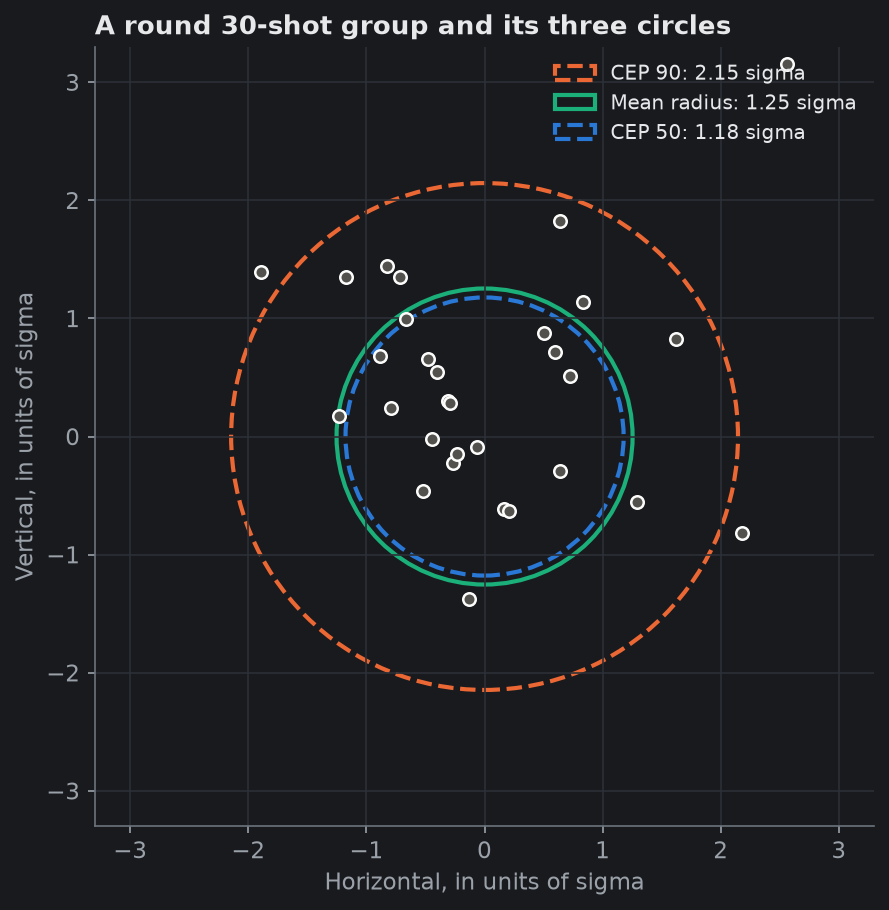
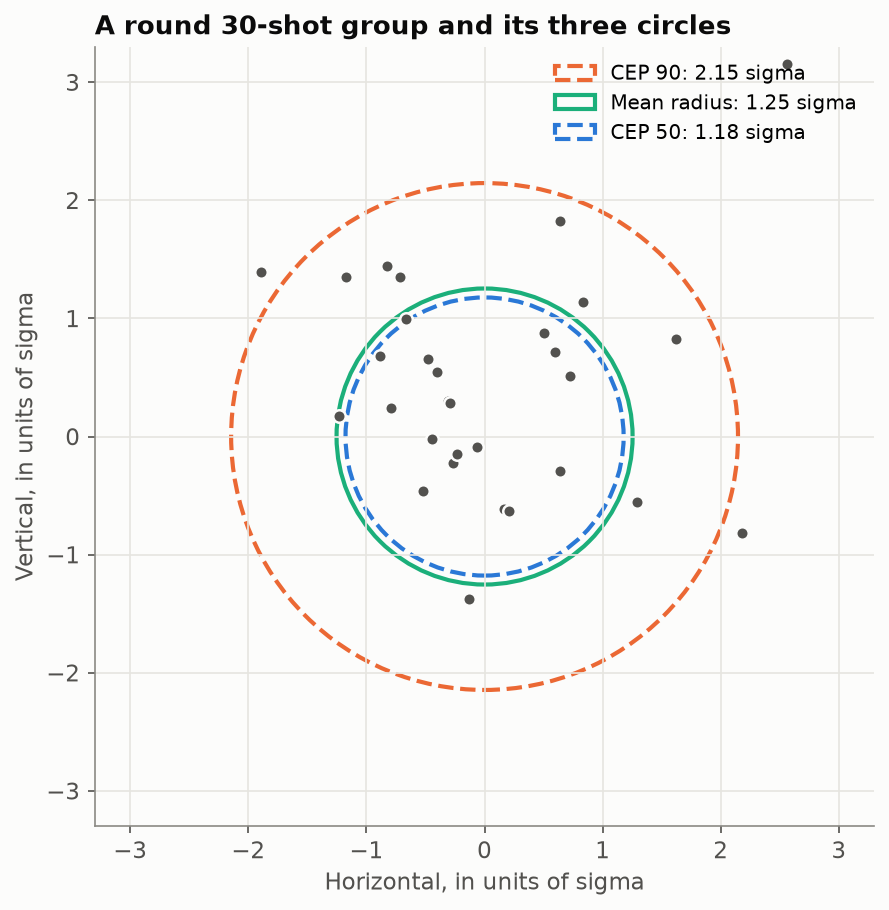
So CEP 50 is always a little smaller than mean radius, and CEP 90 is a little under twice mean radius. None of them carries information the others lack. GroupLab estimates sigma from every shot (the Rayleigh estimate) and derives all of them from it, each with its confidence interval. The intervals are the same width in relative terms, because they come from the same estimate.
In the example above, 17 of the 30 shots fall inside the CEP 50 circle and 27 inside the CEP 90 circle. That is what "about half" and "about nine in ten" look like with real-world luck in a 30-shot sample.
When the group is not round
Many real groups are not round. Vertical stringing from velocity spread or a bad rest, or horizontal spread from wind, stretch the group into an oval. A circle is then the wrong shape for describing it, and the round-group formula starts to drift.
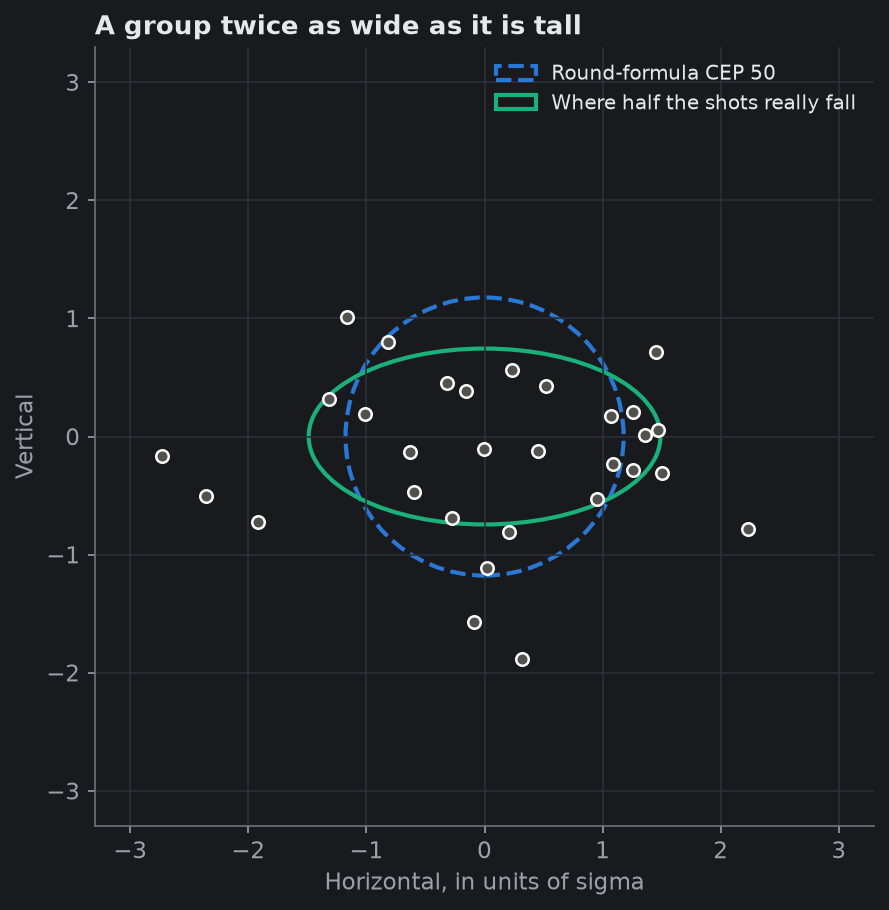
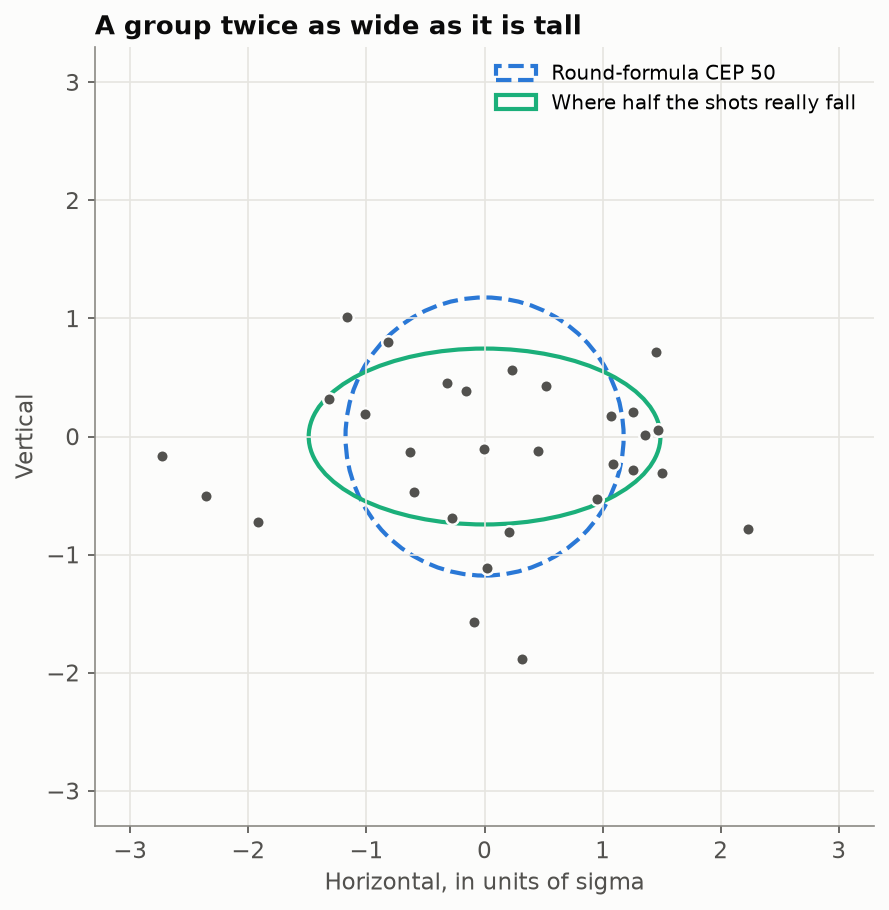
How far does it drift? This chart keeps the total spread the same and stretches the group:
| Long axis to short axis | Shots inside the CEP 50 circle | Inside the CEP 90 circle |
|---|---|---|
| 1 (round) | 50 percent | 90 percent |
| 1.5 | 52 | 90 |
| 2 | 54 | 89 |
| 3 | 57 | 88 |
| 4 | 59 | 88 |
For moderate stretching the round formula holds up surprisingly well. By a ratio of 2 it is off by a few percentage points, which is less than the sampling uncertainty of most groups. Beyond that the circle itself is the problem: an oval group is better described by its width and height separately, which GroupLab also shows.
The shotGroups package, which GroupLab validates against, offers eleven ways to estimate CEP for oval groups. On one reference 20-shot group they disagree by about 15 percent. That spread is worth knowing: for a stretched group, "the CEP" is not one well-defined number.
What GroupLab shows
- CEP 50 as a dotted circle and CEP 90 as a dashed one on the group plot, centred on the group centre, next to the mean radius. CEP 95 is in the figures beside them.
- Each with a confidence interval from the same Rayleigh estimate as mean radius.
- Width and height of the group, so a stretched group is visible as stretched rather than hidden inside a circle, with the spread across and up and down drawn on one scale.
- A verdict on whether the group is round at all: not a warning at some aspect ratio, but a circularity test, which says "Round, as far as 24 shots can tell" when the shots cannot separate the two axes and "Not round" when they can. The error ellipse's aspect and the angle of its major axis are given beside it. That distinction matters here, because with few shots almost every group measures oval and almost none of them is.
Sources
- GroupLab statistics reference, sections 3.4 and 4 (docs/STATISTICS.md).
- David Wollschlaeger, shotGroups R package, including its CEP estimators and reference values. https://cran.r-project.org/package=shotGroups
- Circular error probable. https://en.wikipedia.org/wiki/Circular_error_probable
- Rayleigh distribution. https://en.wikipedia.org/wiki/Rayleigh_distribution