Research › Measuring groups
Velocity SD from 5, 10 and 20 shots
On this page
GroupLab project. Researched and written with Claude. Testing and data collection by the developer. Written 2026-09-22; the data is from Closed-form statistics and simulation, seed 2026.
What we found
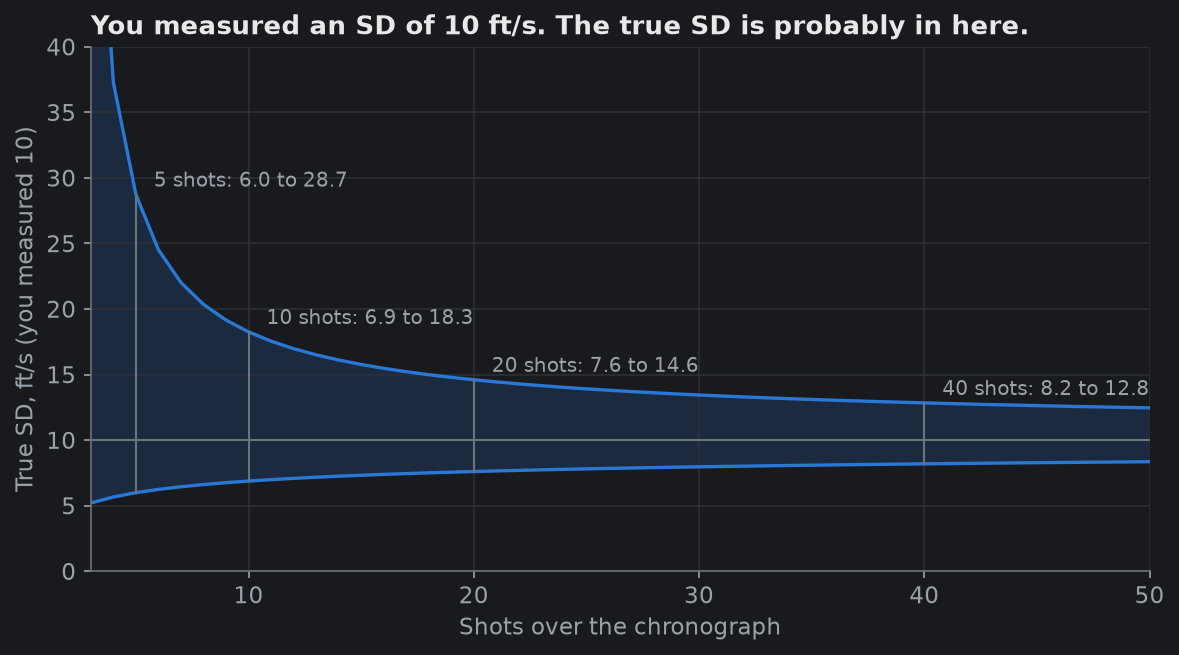
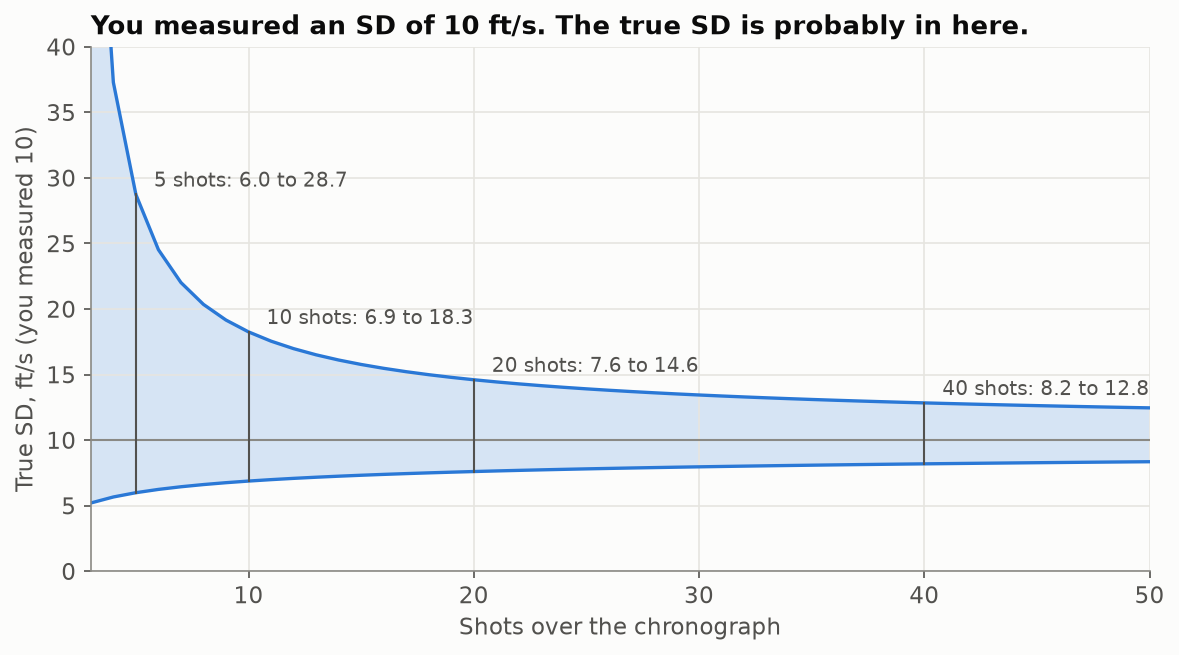
if you chronograph five shots and measure an SD of 10 ft/s, the true SD of that ammunition is, with 95 percent confidence, somewhere between 6.0 and 28.7 ft/s. With 20 shots the same reading narrows to 7.6 to 14.6. Single-digit SD claims from five-shot strings are mostly luck.
How sure we are
exact for normally distributed velocities, which is a good description of well-made ammunition. A string with a genuine outlier (a bad primer, a light charge) is worse than this, not better.
The data
Why velocity SD matters, and why it is hard to measure#
Velocity variation turns into vertical spread at distance: a slower bullet drops more. So handloaders chase a low standard deviation (SD) of muzzle velocity, and chronographs make it easy to get a number.
The number is easy. Knowing whether it means anything is the hard part, because an SD measured from a handful of shots is itself very uncertain.
The interval, string by string#
Suppose your chronograph says SD 10 ft/s. How far could the truth be from that?
| Shots in the string | True SD is between (95 percent) |
|---|---|
| 3 | 5.2 and 62.8 ft/s |
| 5 | 6.0 and 28.7 |
| 10 | 6.9 and 18.3 |
| 20 | 7.6 and 14.6 |
| 30 | 8.0 and 13.4 |
| 50 | 8.4 and 12.5 |
The interval is lopsided: it stretches much further above your reading than below it. Small samples are more likely to understate variation than to overstate it, because a few shots rarely include the extremes.
The same ammunition, measured sixty times#
Here one simulated batch of ammunition with a true SD of exactly 10 ft/s is chronographed thirty times in strings of five, and thirty times in strings of twenty.
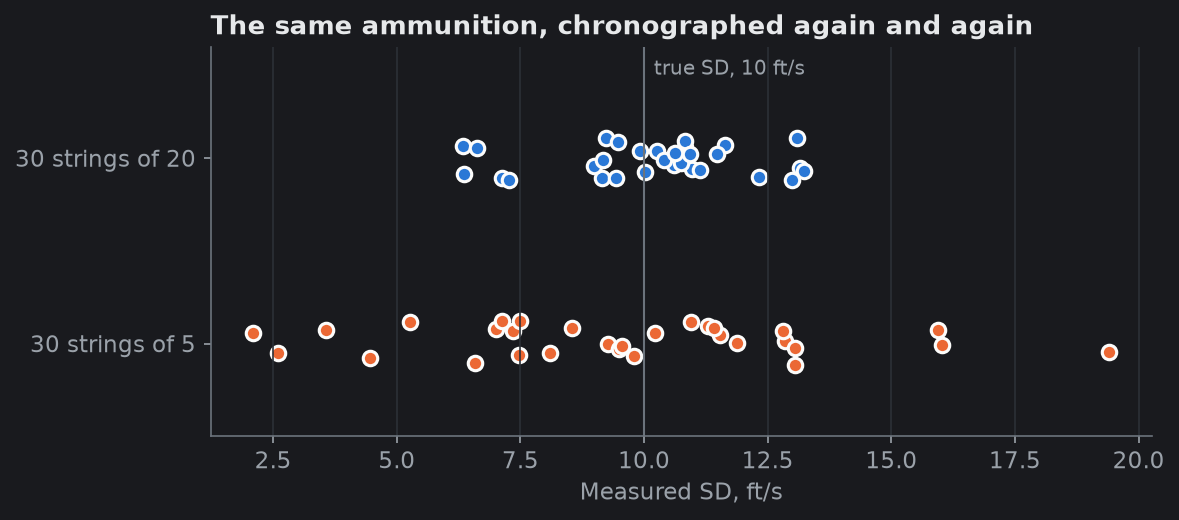
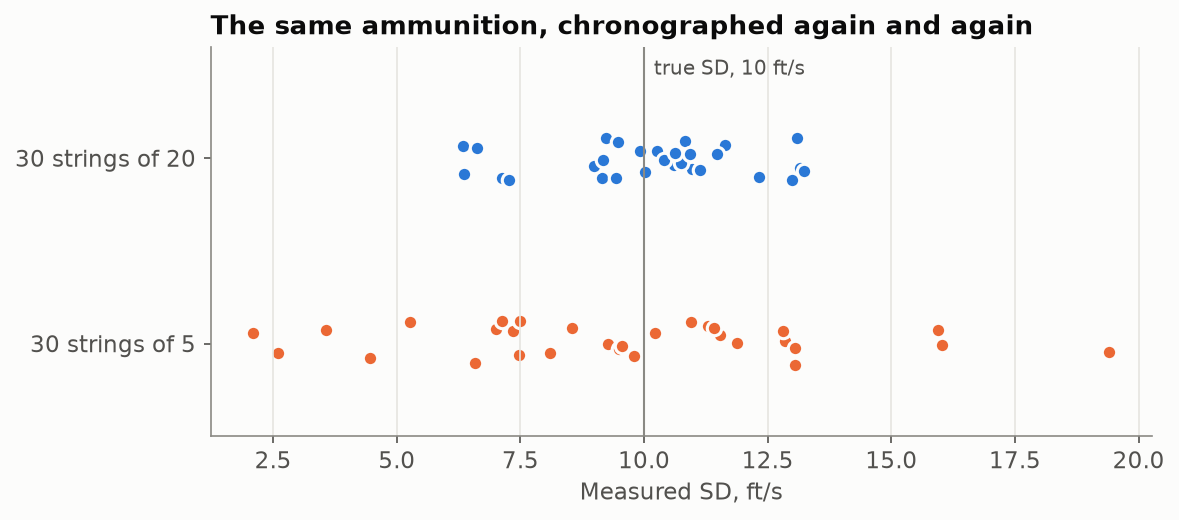
The five-shot strings read anywhere from 2.1 to 19.4 ft/s. Somebody who shot the 2.1 string would believe they had world-class ammunition; somebody who shot the 19.4 string would start over. The twenty-shot strings stay between 6.3 and 13.2.
Velocity extreme spread grows with every shot#
Extreme spread (ES) in velocity, the fastest minus the slowest, has the same problem as extreme spread on paper: it only looks at two shots, and it grows just because you fired more.
| Shots in the string | Average ES as a multiple of the true SD |
|---|---|
| 3 | 1.7 |
| 5 | 2.3 |
| 10 | 3.1 |
| 20 | 3.7 |
| 30 | 4.1 |
So an ES of 25 ft/s over five shots and an ES of 40 ft/s over twenty shots can describe the same ammunition. Comparing ES values from strings of different lengths is comparing different things.
What to do with this#
- Chronograph more rounds. Ten is much better than five; twenty is better again. If you are shooting a 25-shot GroupLab sheet anyway, record every shot's velocity.
- Compare SDs with their intervals. Two loads with five-shot SDs of 8 and 12 ft/s are not shown to be different: identical ammunition gives a gap that size almost half the time. With thirty shots each, the same two readings would be.
- Look at the paper too. Velocity SD is one input to vertical spread at distance. GroupLab can compare the vertical spread you measured with what your velocity spread predicts, which tells you whether velocity is really the limit or whether the rifle, the rest or the shooter is.
- Do not chase a number the sample cannot support. Nothing in this article says small SDs do not matter. It says a five-shot string cannot tell you whether you have one.
What this means#
A single-digit SD from a five-shot string is mostly luck. Measure 10 ft/s over five shots and the true value is somewhere between 6.0 and 28.7 with 95 percent confidence. That range includes both "excellent" and "poor", which is another way of saying five shots did not tell you which you have.
Twenty shots is where the number starts to mean something, narrowing the same reading to 7.6 to 14.6. Still wide, and honest.
So do not chase a load on SD alone from short strings, and be skeptical of anybody quoting one. The claim is not usually dishonest; it is just a reading that has not been given enough shots to become a measurement.
Sources#
- NIST/SEMATECH e-Handbook of Statistical Methods, chi-square test and confidence interval for the standard deviation. https://www.itl.nist.gov/div898/handbook/eda/section3/eda358.htm
- The range of a sample and its relation to the standard deviation. https://en.wikipedia.org/wiki/Range_(statistics)
- GroupLab statistics reference, section 12 on velocity and vertical dispersion (docs/STATISTICS.md).