

Trying GroupLab
What it is, in three sentences
GroupLab measures how accurately a rifle shoots, from a photograph or a scan of a target you have shot. It is built around one idea: a small group tells you far less than shooters think, so every figure comes with the range it could really be, and the software says plainly when the evidence does not support a conclusion. It is free, it keeps everything on your own machine, and it has no account and no network use at all.
This page is for somebody who has never seen it. It is an unfinished test build, and the last section says what is not done.
Getting it
- Download the installer or the zip from the nightly build. That build is published automatically from the newest change that passes the tests, so it is the one to test and the one to name in a bug report. Its address never changes, and every nightly also keeps a release of its own at
v<version>, so a build you named in a report still exists later. The newest numbered release is beside it, and changes only when somebody makes one. - Windows may say "Windows protected your PC". Click More info, then Run anyway. GroupLab is unsigned, because signing costs money the project has not spent; the source of the build is public. On 2026-09-21 two machines installed
grouplab-setup-win-x64.exefrom the nightly release and neither was warned, so it does not always happen; it is not promised either way, because SmartScreen decides per file and per machine and nothing here controls it. - Your antivirus may quarantine it, for the same reason. If it does, the file it took is
GroupLab.App.exe. - The installer puts GroupLab in the Start menu and in Add or remove programs. The zip needs no installing: unzip it and run
GroupLab.App.exe.
Nothing else is needed: the download carries its own .NET runtime.
It keeps itself up to date
The installer's copy updates itself. It looks for a newer nightly when it starts, and a bar appears under the header naming the version, with Update now, Later and Skip this version. Update now downloads it, checks it against the build's signature, saves whatever you have open, says in one line that GroupLab will close and reopen, and comes back on the screen you were on. No installer window and no administrator prompt appear at any point. You can change how often it looks, or turn it off, in the settings.
The zip and the Linux tarball cannot replace themselves, because they were unpacked wherever you put them. They tell you a newer build exists and point you at the download.
If a new build will not start
Nothing of yours is at risk. Everything you have made lives in %APPDATA%\GroupLab: the settings, your sessions, any sheet you designed and the log. No installer and no uninstaller touches that folder, so a bad build cannot lose a session.
Going back is a download, not a repair. The update replaces the program in place, so there is no previous copy on the machine to return to. The build you were on still exists at its own address: open the releases list, find the v<version> release you were on, download its installer and run it. It installs over the broken one, and your things are exactly where you left them.
If that happens, say so in a report. It is the kind of thing that should be rare enough to be worth hearing about every time.
The first minute, with no rifle
Both packages bring a samples folder.
- Open GroupLab. In the header's menu, top right, choose Open image.
- Open
samples/sample-25-shots.png. It is a GroupLab sheet with 25 shots, generated by GroupLab itself, so it is nobody's target. - GroupLab reads the sheet's printed codes, registers the page from the corner markers, finds the holes and puts each on its bull. Watch the status line.
- Settle anything the review queue raises in the side panel, then press Accept and analyse.
Reading what it shows you
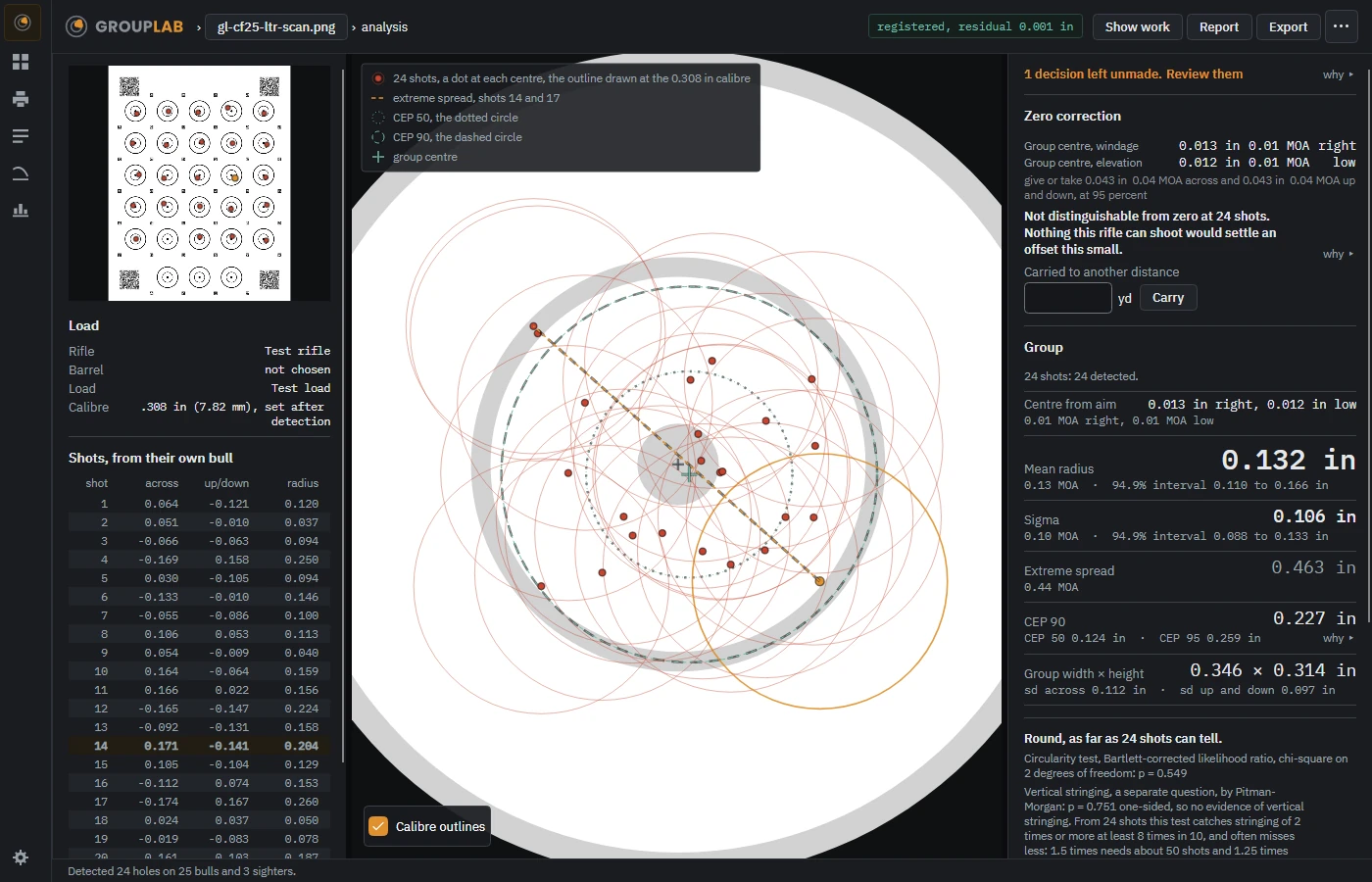
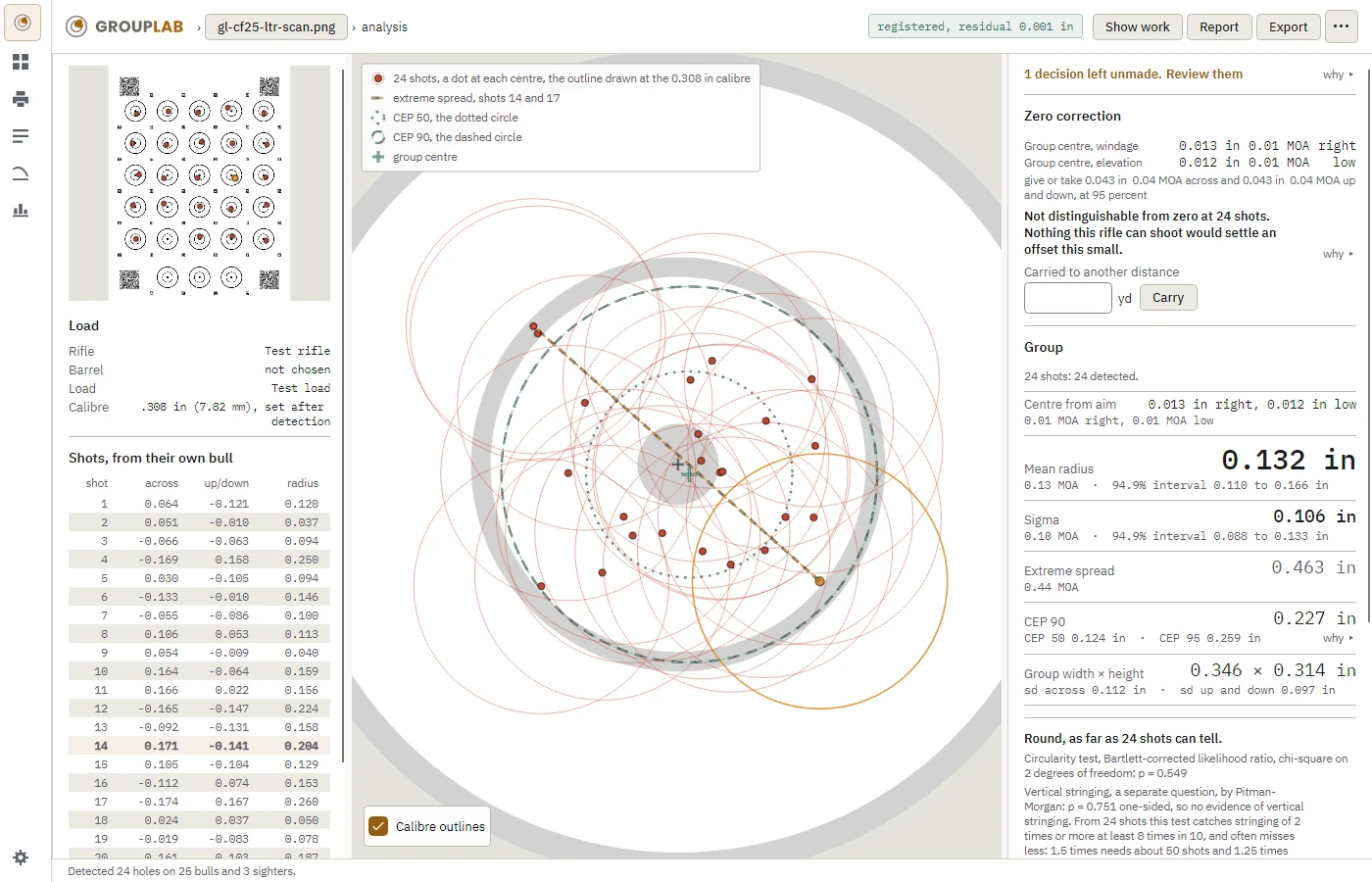
- The plot draws every shot on one bull, each from its own bull's centre, with the group's centre and its CEP 50 and CEP 90 circles.
- Every figure carries its interval: the range the true value is likely to lie in. That interval is the point of the software. A five-shot group's mean radius could easily be half or double what it measures.
- The zero correction says what to dial, in your scope's clicks, and refuses when the group's centre is too close to the aim to tell from chance, saying how many shots would settle it.
- The two cards judge the group's shape and its worst shot, each naming the test it used and what that test could have detected.
- Every "why" opens the reasoning behind a figure.
Printing a sheet and shooting it
The rail on the left has the target library and the print screen: twenty built-in sheets, printed at actual size.
- Print with Open to print, and choose Actual size or 100 percent, never Fit to page.
- Measure bull 1 to bull 5 before you shoot: on the Letter 5x5 sheet it is 5.98 in (152.0 mm). If it is not, the printer scaled the sheet.
- Mount it flat, fire one shot per bull in order, and write only in the load block.
- Photograph it from about 2.5 ft on your phone's main camera with the whole sheet in frame, or scan it flat at 600 dpi. Do not crop it, and do not send it through a messaging app.
- Print a volunteer pack on the print screen gives the sheet and a page of these instructions together.
What is not done yet
The repository's README is the authority on what works; this is the short version.
- Printing from inside GroupLab lost every marker and code on one printer, which made those sheets unmeasurable. That is fixed and held by a test on more than one printer driver, but no sheet from the fixed version has been checked on paper yet, so use Open to print.
- Hole detection on plain paper, with no sheet definition, is not built.
- Garmin Xero import is not built. Chronograph readings are typed in, and reconciled with the shots rather than assumed to line up with them.
- Several of the project's own gates have no material yet: no mounted photograph set, no 25-shot editor timing, no blank-paper photograph. So GroupLab is careful software that has not yet been proved against a large body of real targets.
- Linux and macOS are built and tested on every push. Nobody uses either day to day, and the macOS build is not offered for download.
Telling somebody when it is wrong
The gear at the bottom left opens the settings. The top of that screen names the build: copy that line into any report, because a test build changes whenever the code does. Report a problem there writes a report package: a zip with the log and what GroupLab was doing, carrying no location data and no images unless you add them. Send it with a line about what you were doing.
GroupLab keeps everything in %APPDATA%\GroupLab: settings, your sessions database, any sheet you design, and the log. To remove it, uninstall or delete the folder you unzipped, and delete that folder when you want the data gone.